In the early 1970’s I worked as an instructor in photography in Berlin Germany. I used only black and white film on my 35mm Nikon or my larger format 120mm Hasselblad camera. I developed and printed my own film, as well as color slides. I did not generally do color negative film as the printing process was extremely complex and time consuming compared to the black and white negative film, and the color slides. This was before the time of computers so none of the work involved any computer intervention.
Photography: Learning to See Time
Photography entered my life before I understood art as a lifelong practice. Long before painting became my primary language, the camera taught me how to stay with what was already there. Photography trained my attention. It taught me how to wait, how to frame without intrusion, how to recognize when something had arrived rather than forcing it to appear.
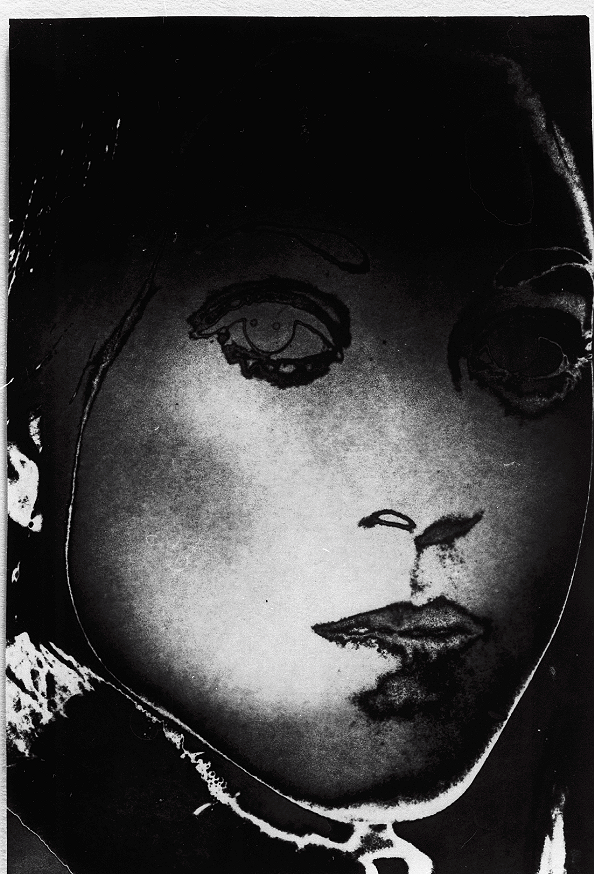
In 1972, I made my first photographic self-portrait series. I did not understand it then as a conceptual act, nor as a statement about identity. I was performing roles or constructing personas. I was observing presence. I was studying what it meant to stand before the camera and remain still long enough to see myself as I actually was, or as I imagined myself to be. These photographs were not declarations; they were inquiries. I did not stay with self-portraiture as a primary mode, but the questions it opened never left me.
From the beginning, photography was less about image-making than about perception. The camera slowed me down. It required patience. It demanded a relationship with time. I learned quickly that the most meaningful images were not taken but received, they emerged when I stopped trying to control the frame and allowed myself to listen. This orientation toward seeing would later become foundational to my painting practice.
Berlin was where photography became inseparable from my life. The city’s weight, its history, its silences, required duration. I worked with long exposures, in a room without a window, allowing light to accumulate slowly on the film. These images were not about capturing moments; they were about inhabiting time. Photography became a way to exist inside uncertainty, to witness without explanation, to remain present in a place shaped by rupture and memory.
I never stopped photographing. The medium continued alongside everything else I made, painting, drawing, performance, installation, not as documentation, but as a parallel practice of attention. Photography is the root system of my work. It is where I learned to see pattern, to recognize structure, to trust emergence. The paintings that followed did not abandon photography; they extended its logic into color, form, and material.




Video: While doing my post-bac and my MFA in studio art, I learned video from Jane Hudson, and Mary Ellen Strom both at the School of the Museum of Fine Arts Boston. I have a small YouTube channel but I have not posted most of my video work.